
Following the airing of the N-word at the BAFTA Film Awards, I wrote to both the BBC and BAFTA to raise serious concerns about how the situation was handled and broadcast.
Racist language should never be normalised or amplified, and it is vital that broadcasters take responsibility for the impact their editorial decisions have on audiences, particularly Black viewers who should not have to see or relive such harm on national television. At the same time, I also highlighted the importance of approaching this issue with care and understanding, particularly in relation to the individual involved, John Davidson, who has Tourette’s. We must ensure that any response is rooted in both accountability and compassion, without stigmatising neurological conditions.
This is about getting the balance right, protecting audiences, standing firmly against racism, and ensuring that people with conditions like Tourette’s are treated with dignity and respect. I will continue to press for clarity on the decisions taken and for stronger safeguards to prevent harm in future broadcasts.
I’m pleased that the BBC has committed to meeting me later this month and hosting a screening of the Bafta winning film I Swear in Parliament in May which follows the life of the Tourette’s campaigner, John Davidson’s life.
Read my full letters below:
BBC
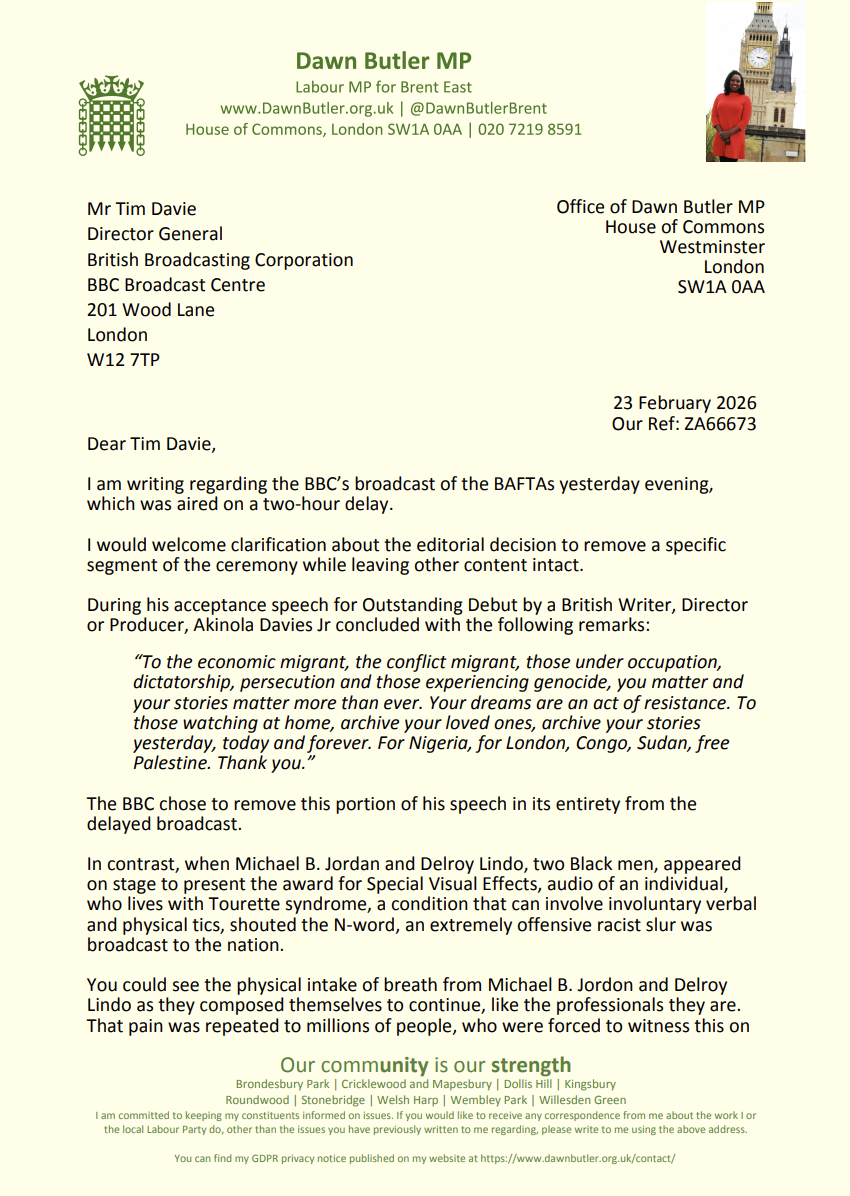
Dear Tim Davie,
I am writing regarding the BBC’s broadcast of the BAFTAs yesterday evening, which was aired on a two-hour delay.
I would welcome clarification about the editorial decision to remove a specific segment of the ceremony while leaving other content intact.
During his acceptance speech for Outstanding Debut by a British Writer, Director or Producer, Akinola Davies Jr concluded with the following remarks:
“To the economic migrant, the conflict migrant, those under occupation, dictatorship, persecution and those experiencing genocide, you matter and your stories matter more than ever. Your dreams are an act of resistance. To those watching at home, archive your loved ones, archive your stories yesterday, today and forever. For Nigeria, for London, Congo, Sudan, free Palestine. Thank you.”
The BBC chose to remove this portion of his speech in its entirety from the delayed broadcast.
In contrast, when Michael B. Jordan and Delroy Lindo, two Black men, appeared on stage to present the award for Special Visual Effects, audio of an individual, who lives with Tourette syndrome, a condition that can involve involuntary verbal and physical tics, shouted the N-word, an extremely offensive racist slur was broadcast to the nation.
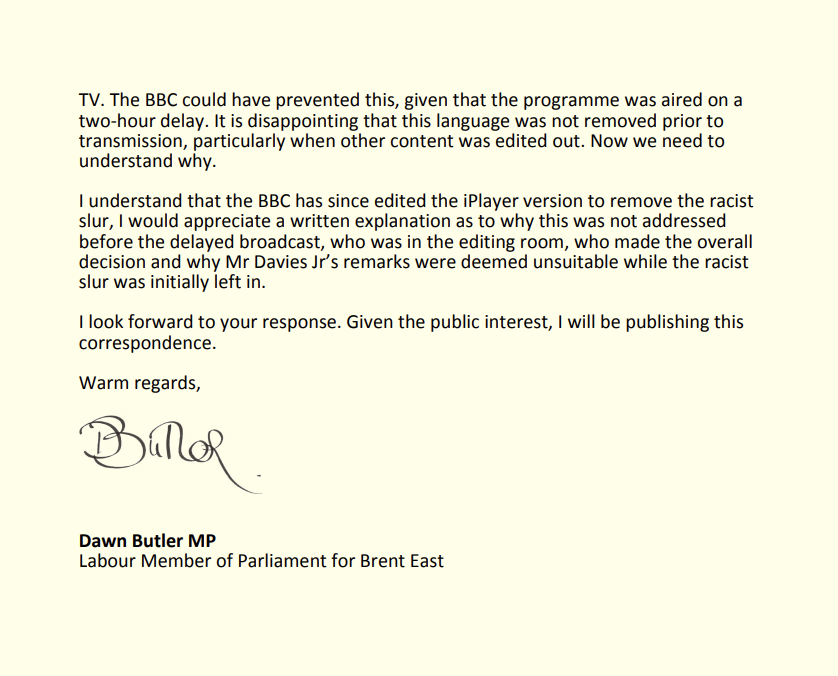
You could see the physical intake of breath from Michael B. Jordon and Delroy Lindo as they composed themselves to continue, like the professionals they are. That pain was repeated to millions of people, who were forced to witness this on TV. The BBC could have prevented this, given that the programme was aired on a two-hour delay. It is disappointing that this language was not removed prior to transmission, particularly when other content was edited out. Now we need to understand why.
I understand that the BBC has since edited the iPlayer version to remove the racist slur, I would appreciate a written explanation as to why this was not addressed before the delayed broadcast, who was in the editing room, who made the overall decision and why Mr Davies Jr’s remarks were deemed unsuitable while the racist slur was initially left in.
I look forward to your response. Given the public interest, I will be publishing this correspondence.
Warm regards,
Dawn
BAFTA
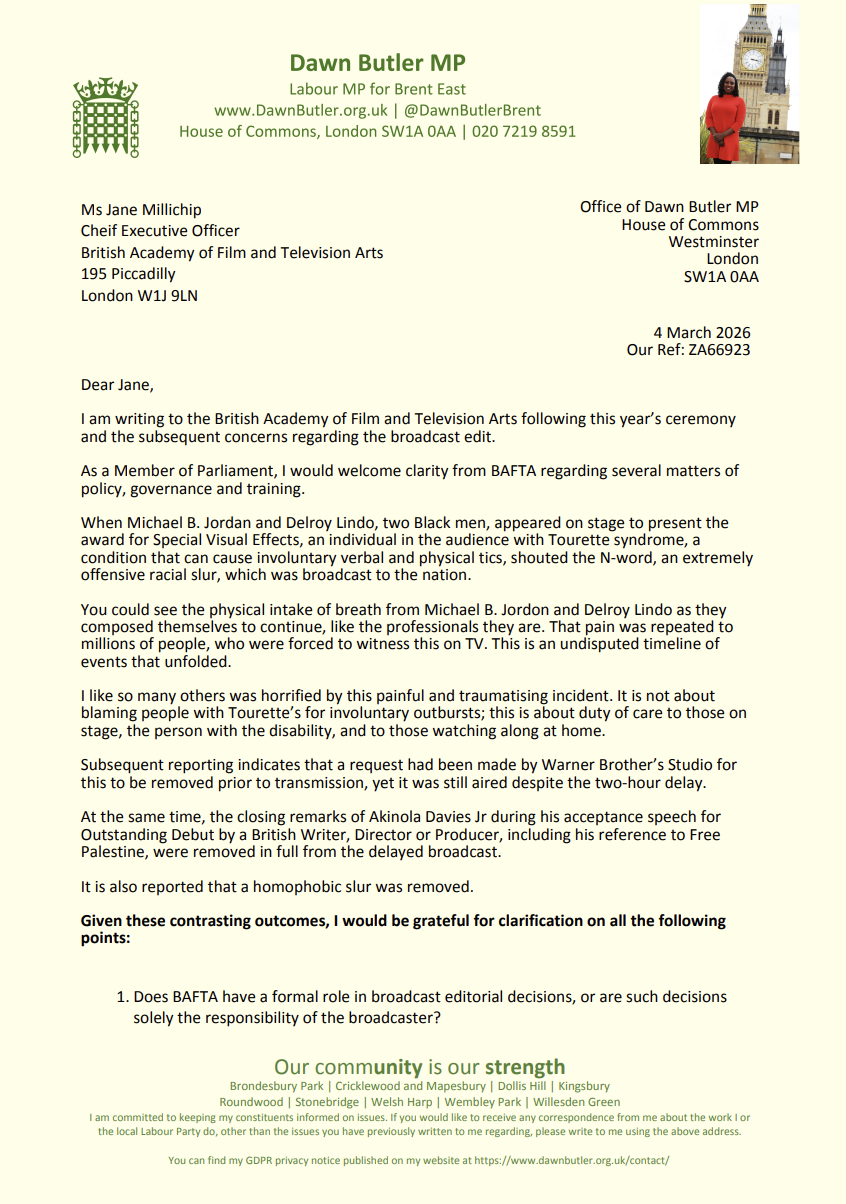
Dear Jane,
I am writing to the British Academy of Film and Television Arts following this year’s ceremony and the subsequent concerns regarding the broadcast edit.
As a Member of Parliament, I would welcome clarity from BAFTA regarding several matters of policy, governance and training.
When Michael B. Jordan and Delroy Lindo, two Black men, appeared on stage to present the award for Special Visual Effects, an individual in the audience with Tourette syndrome, a condition that can cause involuntary verbal and physical tics, shouted the N-word, an extremely offensive racial slur, which was broadcast to the nation.
You could see the physical intake of breath from Michael B. Jordon and Delroy Lindo as they composed themselves to continue, like the professionals they are. That pain was repeated to millions of people, who were forced to witness this on TV. This is an undisputed timeline of events that unfolded.
I like so many others was horrified by this painful and traumatising incident. It is not about blaming people with Tourette’s for involuntary outbursts; this is about duty of care to those on stage, the person with the disability, and to those watching along at home.
Subsequent reporting indicates that a request had been made by Warner Brother’s Studio for this to be removed prior to transmission, yet it was still aired despite the two-hour delay.
At the same time, the closing remarks of Akinola Davies Jr during his acceptance speech for Outstanding Debut by a British Writer, Director or Producer, including his reference to Free Palestine, were removed in full from the delayed broadcast.
It is also reported that a homophobic slur was removed.
Given these contrasting outcomes, I would be grateful for clarification on all the following points:
- Does BAFTA have a formal role in broadcast editorial decisions, or are such decisions solely the responsibility of the broadcaster?
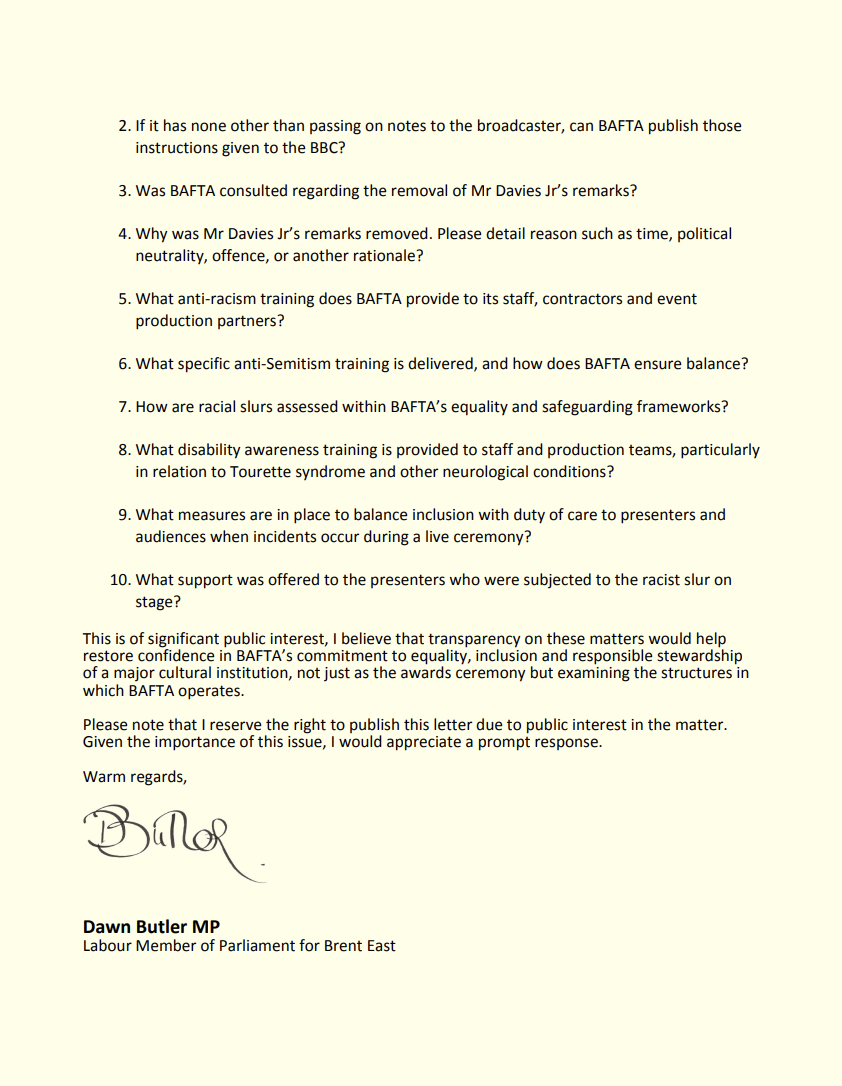
- If it has none other than passing on notes to the broadcaster, can BAFTA publish those instructions given to the BBC?
- Was BAFTA consulted regarding the removal of Mr Davies Jr’s remarks?
- Why was Mr Davies Jr’s remarks removed. Please detail reason such as time, political neutrality, offence, or another rationale?
- What anti-racism training does BAFTA provide to its staff, contractors and event production partners?
- What specific anti-Semitism training is delivered, and how does BAFTA ensure balance?
- How are racial slurs assessed within BAFTA’s equality and safeguarding frameworks?
- What disability awareness training is provided to staff and production teams, particularly in relation to Tourette syndrome and other neurological conditions?
- What measures are in place to balance inclusion with duty of care to presenters and audiences when incidents occur during a live ceremony?
- What support was offered to the presenters who were subjected to the racist slur on stage?
This is of significant public interest, I believe that transparency on these matters would help restore confidence in BAFTA’s commitment to equality, inclusion and responsible stewardship of a major cultural institution, not just as the awards ceremony but examining the structures in which BAFTA operates.
Please note that I reserve the right to publish this letter due to public interest in the matter. Given the importance of this issue, I would appreciate a prompt response.
Warm regards,